
This article originally appeared in The Hub.
By Ed Fast, January 8, 2026
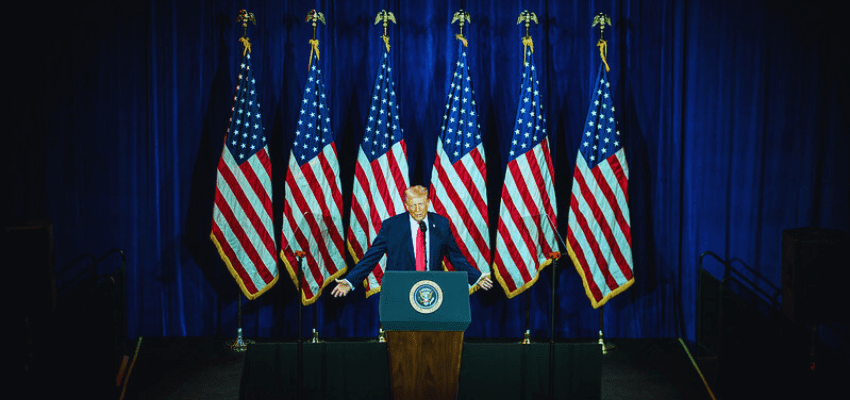
President Donald Trump’s National Security Strategy (NSS), released last month, contains troubling implications for Canada—not through what it directly says about our nation, but through what it assumes and demands. Now, with Trump’s actions in Venezuela to remove dictator Nicolás Maduro demonstrating the American president is serious about the strategy’s core focus on Western Hemispheric dominance, it’s even more vital that Canadian leaders consider the NSS’s implications on our own foreign policy.
Presently, Prime Minister Mark Carney is attempting to navigate a nasty tariff war and a looming CUSMA renegotiation while simultaneously pursuing a strategic reset with China, including visiting the country next week to talk trade and security with President Xi Jinping. This leaves Canada caught between competing imperatives that may prove impossible to reconcile.
The NSS presents a “Trump Corollary to the Monroe Doctrine,” which the president has since come to call the “Donroe Doctrine,” envisioning the Western Hemisphere as an American sphere of influence where Washington will “deny non-Hemispheric competitors the ability to position forces or … own or control strategically vital assets.” The document focuses heavily on Latin America’s instability and migration challenges, while Canada appears implicitly categorized as part of the solution rather than the problem—an “established friend” expected to help “control migration, stop drug flows, and strengthen stability and security on land and sea.”
This could work to Canada’s advantage. Unlike America’s southern neighbours, we are not viewed primarily through a security threat lens, although Trump’s Section 232 national security tariffs against Canadian steel, aluminum, copper, and wood seem to run counter to this. The strategy’s emphasis on “near-shoring manufacturing” and developing hemispheric supply chains aligns well with Canadian economic interests, particularly in critical minerals, energy, and advanced manufacturing.
However, the document’s language reveals an administration that sees hemispheric partnerships as transactional, where compliance is expected, not negotiated. The strategy explicitly states that alliances and aid “must be contingent on winding down adversarial outside influence.” This presents Canada with an uncomfortable ultimatum.
The tensions in Canada’s position
Carney has been explicit about his intentions toward China. At the 2025 APEC summit in South Korea, he met with President Xi for the first formal leader-to-leader contact since 2017, calling it a bilateral turning point. Carney told reporters he aims to diversify Canada’s trade: “Never have all your eggs in one basket. We have too many eggs in the American basket.” He added Canada must “grow others, and the ‘s’ is a capital ‘s’ at the end of others.”
More pointedly, Carney told a business audience in Asia that the world of rules-based liberalized trade had ended, and Canada aimed to double its non-U.S. exports over the next decade. He accepted Xi’s invitation for a state visit to China and left the door open to easing investment restrictions, negotiating a free trade deal, and even lifting Canada’s 100 percent tariffs on Chinese electric vehicles imposed in 2024.
This makes economic sense from Ottawa’s perspective: China remains the world’s second-largest economy and a crucial market for Canadian resources struggling under Chinese counter-tariffs on canola, pork, and seafood.
But the NSS could not be clearer about its expectations. It describes decades of engagement with China as a catastrophic mistake, and vows to “rebalance America’s economic relationship with China.” It explicitly states the need to align with allies “in preventing domination by any single competitor nation.”
The strategy goes further, warning America will monitor and resist Chinese “control of military installations, ports, and key infrastructure.” Given Chinese investments in Canadian mining, technology, and infrastructure, this language should set off alarm bells in Ottawa.
In recent statements, Carney established what he calls “guardrails” for China relations, suggesting Canada would not pursue deep relationships in areas like artificial intelligence, critical minerals, and defence. But these guardrails may prove inadequate given Washington’s expansive definition of strategic vulnerability. When Carney says he wants a “pragmatic and constructive” relationship with China—addressing “irritants” while maintaining areas of cooperation—he is describing precisely the kind of strategic ambiguity Trump’s NSS rejects.
Crucially, the current tariff dispute between Canada and the U.S. must be understood not merely as a trade spat but as part of this broader strategic framework. The NSS embraces tariffs as “powerful tools” with an emphasis on “reducing trade deficits” and “ending dumping and other anti-competitive practices.”
Canada’s recent tiny trade surplus with the U.S., however modest compared to China’s, makes us a target under this doctrine. The strategy’s insistence that “America’s current account deficit is unsustainable” suggests that even balanced economic relationships may face pressure to tilt further in America’s favour.
The document’s repeated emphasis on “fairness” and ending ally “free-riding” reveals an administration convinced that previous arrangements fundamentally exploited American generosity. Canada’s modest defence spending, currently about 1.4 percent of GDP—well below NATO’s 2 percent target, let alone the new 5 percent “Hague Commitment”—will be leveraged.
The implication is clear: Canada’s access to American markets, technology, and favourable trade treatment will be contingent on dramatically increased defence spending and alignment with U.S. strategic priorities, particularly regarding China.
Difficult strategic choices ahead
One area where Canadian and American strategic interests genuinely align is Arctic security. NORAD modernization, enhanced Arctic surveillance, and northern infrastructure investments could offer tangible proof of Canada’s continental defence commitment. Addressing American security concerns while advancing Canada’s own Arctic sovereignty claims would be a rare win-win in an otherwise challenging environment.
Still, Carney faces an impossible strategic triangle: he cannot simultaneously reset relations with China to diversify Canada’s economic partnerships away from the U.S., maintain preferential access to American markets, and resist American pressure to dramatically increase defence spending and align completely with U.S. strategic priorities.
The NSS makes explicit that countries must choose “an American-led world of sovereign countries and free economies” or alignment with nations “on the other side of the world.” No middle path is contemplated.
Canada’s historical approach—threading the needle between American partnership and independent foreign policy—may no longer be viable under an administration that views strategic ambiguity as betrayal and transactional relationships as the only honest form of alliance. Yet Carney’s statement on the events in Venezuela, which mentioned neither America nor its president, sees him still trying to walk this line. If Trump takes further steps to assert hemispheric influence, like trying to wedge Mexico out of CUSMA negotiations to form a bilateral deal with Canada, Carney may have to pick his battles.
Preserving the bilateral relationship while maintaining some degree of Canadian policy independence will necessitate several difficult choices.
First, Ottawa must recognize that a reset with China cannot proceed as planned without serious consequences to the U.S. relationship. Chinese investment in strategic sectors will be viewed through a national security lens in Washington.
Second, Canada must make a credible commitment to dramatically increased defence spending, with a focus on continental defence capabilities: Arctic surveillance, missile defence, naval expansion, and cyber capabilities—framed not as capitulation to America but investments in Canadian sovereignty.
Third, Canada should lean into economic opportunities the NSS explicitly offers: critical minerals development, energy sector partnership, advanced manufacturing, and supply chain integration. These align with both nations’ interests and provide tangible proof of Canadian strategic value.
Finally, Ottawa must engage in clear-eyed diplomacy. The days of assuming American patience with allied free-riding are over. The NSS does not explicitly threaten Canada, but neither does it exempt us from its demands. We are implicitly counted among America’s allies expected to align with Washington’s strategic priorities.
Carney’s attempt to reset relations with China while navigating a tariff war with the U.S. is not merely politically difficult, it may be strategically impossible under the NSS framework. The question facing Canada is not whether our bilateral partnership with the U.S. will change, but whether we will shape that change through proactive strategic choices or have it imposed upon us through economic coercion.
The partnership can be enhanced, but only if Canada accepts the new terms of engagement: concrete contributions to continental defence, alignment on China policy, and recognition that strategic ambiguity is no longer tolerated. The alternative is a relationship defined by tariffs, exclusion from supply chains, and treatment as an unreliable partner.
The choice, for now, remains Canada’s to make. But the window for choosing is rapidly closing.
The Hon. Ed Fast served as Canada’s minister of international trade from 2011-2015, leading free trade negotiations with the European Union, the Trans-Pacific Partnership countries, South Korea, and Ukraine. He is also a distinguished fellow at the Macdonald-Laurier Institute.