
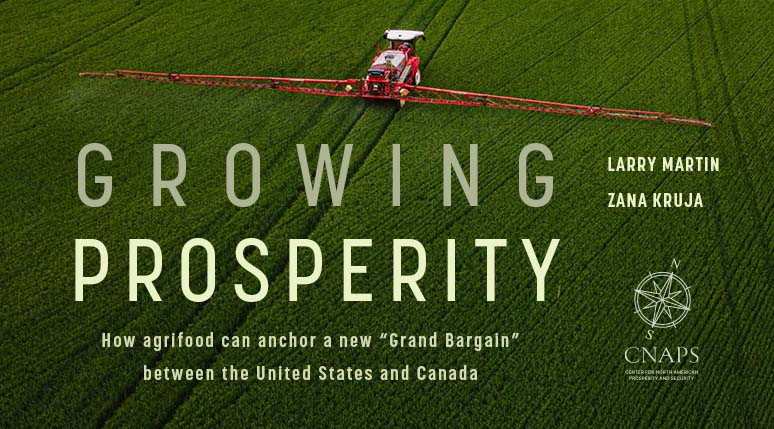
By Larry Martin and Zana Kruja
January 15, 2026
Executive Summary
As trade tensions once again dominate headlines in both the United States and Canada, we face a stark choice. We can continue lurching from one tariff fight to the next – or pursue a durable reset of the bilateral economic relationship that underpins prosperity on both sides of the border.
The current moment demands the latter.
Rather than treating agriculture as a recurring flashpoint or a bargaining chip, a more comprehensive approach is needed – one that goes beyond a narrow US-Canada trade treaty. What we need is a “Grand Bargain” that reflects how deeply integrated and mutually dependent our two countries already are in a host of areas, including North American defense and security, environmental management, and more.
Our interconnected food system means that when that system is disrupted, farmers, consumers, and industries in both countries bear the costs.
Agriculture offers a practical and politically credible starting point for rebuilding trust and stability. In this paper, we examine four areas where deeper cooperation – or at a minimum, avoiding further disconnection – would reduce costs, improve food security, stabilize prices, and strengthen resilience for producers and consumers in both countries. Closer integration is not a concession on either side, but a shared opportunity to manage risk, counter external competitors, and secure reliable agriculture input supplies.
There are several key areas that the United States and Canada could work together to improve, including:
Production Risk Management
Agricultural production is inherently exposed to weather and disease risk, which can have severe effects on output and prices. For instance, fluctuations in US production of corn, wheat, and soybeans often move counter to those in Canada: when output in one country peaks, the other tends to experience a trough. Maintaining historically low-or-zero tariff structures – and, where possible, further integrating these markets – would therefore help both countries reduce the risk of food shortages and price volatility.
Furthermore, as international commitments like recent fixed- or minimum-quantity agreements become more common, the risk of becoming an unreliable supplier increases. Low to zero tariffs give both countries greater flexibility to meet international commitments by allowing each to source products from the other in the event of a domestic shortfall.
Potash
Potash, the form of potassium used in fertilizer, is essential for plant growth. The US has a limited endowment of it: 90 percent of the potash it uses is imported, including 80 percent from Canada. As a result, US prices are highly sensitive to tariffs. The other major suppliers are strategic rivals: Russia, Belarus, and China. It is therefore clearly in the US interest to maintain a positive trading relationship with its close ally and neighbor Canada to ensure reliable access to potash at market prices.
Dairy and Poultry Supply Management
Canada’s supply management system for dairy and poultry is a particular thorn in the Trump Administration’s side. Canada uses it to fix supply and prices and to control imports. US industry groups argue that removing it would increase their exports to Canada. This claim can only be tested if both countries have fair market access to each other. However, if Canada unilaterally ended supply management, a fair market would not exist for dairy. That’s because the US market remains more protected than the Canadian market.
Ironically, supply management has resulted in higher costs across Canada’s agriculture sector, impacting land prices, financing costs, and property taxes. It also limits market access for non-supply-managed sectors and restricts quota movement, preventing the industry from achieving economies of size and location.
Clearly, supply management will need to be reformed as part of a US–Canada Grand Bargain on trade. However, reform will also require:
• A phased opening of the US dairy market, including defining Canadian milk as equivalent to US product.
• A gradual reduction of tariffs over approximately 10 years, with tariff-rate quotas (TRQs) frozen.
• Compensation for Canadian producers who invested in quota over the past 20 years, based on the additional income a reasonably sized farm would have earned had supply management remained in place.
Further Harmonization of Agriculture and Food Approvals and Inspection Systems
The health and safety systems of both countries have come under increasing criticism in recent years. Canada’s system is slow, inconsistent, costly, and discourages innovation. While some cooperation already exists between the two countries, much greater harmonization is possible. Improved alignment could enhance health outcomes while reducing costs and increasing efficiency across the North American food system.
Ultimately, agriculture is not a side issue to be managed at the margins of the US-Canada relationship – it is a strategic asset that touches food security, national security, and economic resilience in both countries. In a world of growing volatility, neither the United States nor Canada can afford to treat its closest agricultural partner as a contingency rather than a cornerstone. Embedding agriculture at the heart of a broader US-Canada Grand Bargain would lock in mutual reliability, reduce shared risks, and send a clear signal that North America intends to compete, feed itself, and lead together in an uncertain global economy.
Read the full paper here: