

This article originally appeared in the Globe and Mail.
By Peter Menzies, January 5, 2026
Given a choice between abandoning its longstanding affection for supply management and the yet-to-be-fully-implemented Online Streaming Act, it appears likely it will be the latter that Canada sacrifices this year in trade talks with the United States.
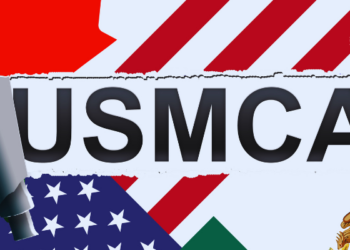
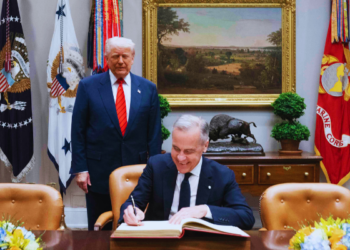
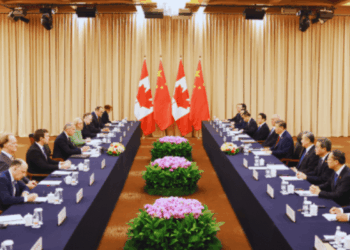
Those two items, along with the Online News Act, are among the key irritants put on the table in December by U.S trade representative Jamieson Greer as his country prepares to renegotiate the U.S.-Mexico-Canada Agreement (USMCA). In response, Prime Minister Mark Carney reaffirmed that supply management, specifically in terms of the tariffs Canada applies to U.S. dairy imports, is not on the table.
Mr. Carney is clearly on the back foot heading into negotiations. If he is to have any hope of preserving supply management’s sacred-cow status, the choice seems clear: dump the digital legislation overboard.
This will not be easy. The Online Streaming Act was the result of lobbying by the TV, film and cable industries that wanted to “level the playing field” by placing all audio and video internet content under the authority of the CRTC. Essentially, the move was designed to replace declining revenue from a five-per-cent levy on domestic cable revenues with something similar derived from offshore (and mostly American) streaming services such as Netflix and Spotify. As evidenced by its recent decision directing streamers to provide described video, the CRTC has also made it clear it intends to regulate the streaming world with the same vigour it has applied to the declining television and cable worlds.
Fortunately for the streamers – and very much as predicted by critics – the CRTC has become so mired in procedural muck that it has failed to fully implement the act, meaning there will be less to untangle if required. When the Online Streaming Act was passed in the spring of 2023, both then-heritage minister Pablo Rodriguez and CRTC Chair Vicky Eatrides expressed confidence the process would be complete by the end of 2024. Eight of the 11 decisions the latter has made so far concerning streamers have taken at least eight months; three took more than a year, and another decision based on a process that began in 2024 has been promised for early 2026.
Despite a 50-per-cent staff increase since early this century, the overwhelmed CRTC has put broadcasters in a state of stasis through license auto-renewals, while other matters, such as disputes once efficiently resolved in months, are dragging on for several years, often at great commercial cost.
Significantly, the CRTC has also allowed itself to be lured into the business of using its new authority as a means to create additional funding mechanisms for broadcaster-based newsrooms. Angry that Mr. Carney has so far refused to make CRTC licensees eligible for the Journalism Labour Tax Credit – and further alarmed that they were sidelined while $150-million in additional funding was granted to the CBC, their major competitor – broadcasters had a lot of hope the CRTC would use the Online Streaming Act to bail them out. But most TV and radio newsrooms other than the CBC are a shell of their former selves. TVA responded to Mr. Carney’s November budget with layoffs. With the streaming act’s future now uncertain and the CRTC’s regulatory lassitude at its peak, more layoffs appear inevitable.
Adding to the difficulties already outlined, court appeals by streamers of some of the CRTC’s decisions to date will take years to resolve, with the regulator’s pending decision anticipated to trigger even more appeals and delays.
In other words, it’s a mess. Even before Mr. Greer put the legislation on the table, the world was unfolding almost exactly the way the Online Streaming Act’s critics had predicted it would since it was first introduced as Bill C-10 in late 2020.
The good news for Mr. Carney is that the legislation in question is really all about the money. Any unrest within the cultural and creative sectors, should he be forced to abandon the streaming act, can be eased by writing more cheques from the Treasury to make up the difference in lost revenue.
Sure, it will be expensive, but spending doesn’t appear to be the issue it was a year ago when Justin Trudeau was prime minister. And the cost of trying to keep already problematic legislation at the expense of a stable USMCA would be much, much higher.
Peter Menzies is a Macdonald-Laurier Institute Senior Fellow, a past publisher of the Calgary Herald, and a former vice chair of the Canadian Radio-television and Telecommunications Commission (CRTC).