
This article originally appeared in The Globe and Mail.
By Fen Osler Hampson and Tim Sargent, July 22, 2026
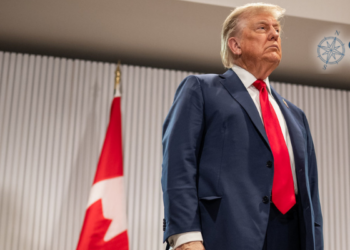
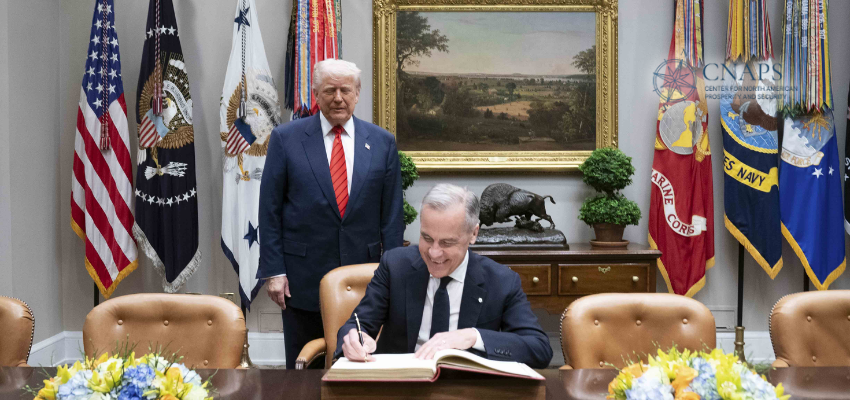
Donald Trump’s latest tariff tantrum, delivered the day after the World Cup finals, was a sucker punch to Prime Minister Mark Carney, who was seated with the President during the match.
The new measures, which were announced Monday, impose 50-per-cent duties on roughly US$20-billion worth of Canadian goods, from milk and cream to alcohol, hockey equipment and electrical machinery, and are set to take effect on Aug. 19. The administration cast them as retaliation for what it calls Canada’s unfair treatment of American dairy, alcohol and automakers. Tellingly, the list spares energy, potash and critical minerals – all things the U.S. urgently needs from us right now, along with goods already captured by the separate steel and auto tariffs.
The President has clearly cooled on Mr. Carney, whose January speech on the global “rupture” in Davos clearly still rankles Mr. Trump. He may still respect our Prime Minister, but he plainly does not like him.
But perhaps more to the point, it is also clear that Mr. Trump and his advisers have grown increasingly frustrated with what they see as Canadian intransigence at the bargaining table. Canada has refused to move on the list of some a dozen or so irritants that U.S. trade representative Jamieson Greer presented last year, insisting instead that Washington first lift its punitive tariffs on our steel, aluminum, lumber and autos before serious negotiations can begin.
The problem on the Canadian side is that it is not clear what our overall strategy is, other than to rag the puck and hope that a stinging defeat in November’s midterm elections make Mr. Trump more willing to compromise – or that he is eventually impeached and we can deal with someone else.
But playing a strong defensive game is not the way to notch goals, as the World Cup finale showed. At some point you have to be aggressive and put yourself in a position to score.
With both sides now agreeing to “intensify discussions,” as Mr. Carney said on Tuesday, we need to be firm with the Americans that this is not a one-way negotiation where they make demands and we succumb. Reciprocity is key.
But we also have to be clear with ourselves about the issues on which we will need to make real concessions, like supply management and dairy, where the Americans have a legitimate complaint because we have been gaming the rules to our advantage. We need to be alert for issues on which we can easily concede, such as the Trump government’s demand for 50-per-cent U.S. content in autos, which we already meet and is very much targeted at Mexico. However, we also need to be clear that destroying our auto sector is a red line for us.
The other thing we have to recognize is that now is a good time to drive a hard bargain. Mr. Trump has landed himself in a real pickle over his conflict with Iran. The ceasefire he prematurely claimed as a victory now lies in tatters, and both sides appear to be on an ineluctable escalation curve. As the price of oil climbs, Mr. Trump may not be so cavalier about the proposition Mr. Carney floated last year, of doubling our oil exports to the United States. The same applies to critical minerals, where Mr, Trump has made clear he wants America first in line for whatever we eventually pull out of the ground and refine.
This is not the time to panic and cave to Mr. Trump’s demands. But it may be time for Canada to sit down and put some of its cards on the table. Part of the strategy must also be to state clearly – publicly and forcefully – where Canada’s and the U.S.’s interests are aligned, and where they diverge.
It is also time for Mr. Carney to expand his team. Unless the Prime Minister intends to do all the negotiating himself, he needs to tap trade experts who can see the bigger picture, such as former Canadian trade negotiator Steve Verheul or former U.S. ambassador Kirstin Hillman. The Prime Minister’s role is to provide strategic direction, ask the right questions, and weigh in only when the key choices and trade-offs have to be made. Trying to play all the positions at once against a bullying opponent is not a winning strategy.
Fen Osler Hampson is Chancellor’s Professor at Carleton University and co-chair of the Expert Group on Canada-U.S. Relations.
Tim Sargent is a senior fellow at the Macdonald-Laurier Institute, director of economic growth and prosperity at the University of Calgary’s School of Public Policy and former deputy minister of international trade.