

This article originally appeared in The Hub.
By Peter Menzies, August 6, 2026
Poignantly, it was three years ago this month that the Liberal government’s plan to plunder the coffers of Big Tech in order to line the pockets of the nation’s news, film, and TV industries began to unravel.
It was in August of 2023, not long after passage of the Online News Act, that Meta began to ban links to news stories on Facebook and Instagram. That was because the premise of the legislation was that Meta and Google should be paying publishers for content they were allowed to post for free.
Critics rightly labelled the bill a shakedown, but, convinced of the value of their content, the drive by publishers to get “money from web giants” had rolled on. While publishers once fantasized about a billion-dollar bonanza, their take wound up being a $100 million Google fund split between more than 400 eligible recipients—minus the loss of commercial agreements and what Meta estimated to be more than $200 million in eyeballs value.
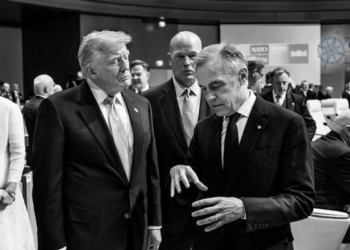
Thus did the folly fuelling Canada’s naive approach to the technology revolution first become blatant. Two years later, it accelerated when, with Mark Carney having replaced Justin Trudeau as prime minister, Canada kiboshed its provocative Digital Services Tax at the behest of U.S. President Donald Trump.
Then, last week, came confirmation of the final collapse of Canada’s decade-long efforts to reel in rather than ride the digital wave. It was confirmed that the government had abandoned its plan, via the Online Streaming Act and the Canadian Radio-television and Telecommunications Commission (CRTC), to force foreign streamers such as Spotify, Netflix, and Disney to fund the nation’s film, TV, music, and broadcast news industries.
The CRTC had spent more than three years trying to implement the Online Streaming Act. With earlier decisions appealed to federal court, it had triumphantly announced in May that streamers would be required to pay 15 percent of Canadian revenues—an estimated $200 million—to support the Canada Media Fund (CMF) and other subsidies, including one for broadcast newsrooms.
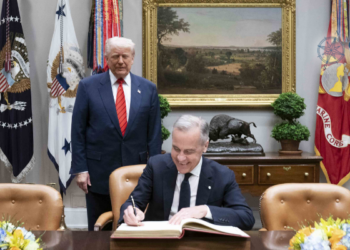
The Online Streaming Act is fiercely opposed by U.S. Trade Representative Jamieson Greer, and Prime Minister Mark Carney moved swiftly to put the decision on ice, announcing the government would, instead of getting money from web giants, be getting $600 million from taxpayers to make up the difference. Documents obtained by The Wire Report then showed the Carney government’s “intention is to eliminate the base contribution requirement on streaming services and to provide government funding to replace those contributions.”
Carney explained that he’d made this decision two months ago and that it was really all about mitigating the impact these higher fees would have had on consumers.
“No, not at all,” he said, straight-faced, when asked if this was another concession to the Americans, even though, when the CRTC decision was initially spiked, Marc Miller, minister of Canadian identity and culture, said, “It is no secret to anyone who has been paying attention that the United States Trade Representative has identified these issues as a trade issue.”
This decision and Carney’s truthy explanation might appear to be a simple matter of government plucking some more cash from the money tree to replace that which was about to be grabbed from streamers. But it isn’t. The federal government is now, essentially, the broadcasting regulator. The Online Streaming Act amended the Broadcasting Act, and it is now Cabinet that will decide what parts of it the CRTC will apply and how.
Government is also now the primary, perhaps sole, funder of certified Canadian Content (CanCon). While the regulator once provided a long-term, stable, and predictable source of funds, the government will now be deciding from year to year how much money it will supply to music, broadcasting, and film and television production industries. The system, in other words, is now fully politicized.
The CRTC, meanwhile, is left to decide if its 5 percent levy on cable revenues and its efforts to lower CanCon contributions from broadcasters in order to level the playing field with streamers will remain in place.
But who knows? Perhaps this independent arms-length administrative tribunal will just have to call the Prime Minister’s Office to find out what its next steps should be.
What is known is that everything the regulator has been working on for the past three-plus years has gone out the window. And while, so long as the money keeps flowing, there won’t be full-blown panic within a film and TV production sector that has already vowed to have Carney’s back, the era of uncertainty that was already hobbling broadcasters now looks permanent. Given that the CRTC had put all broadcasting licenses on auto-renewal pending the outcome of its Online Streaming Act deliberations, there is no opportunity for innovation and adaptation within a swiftly changing environment (a majority of households are expected to have cut the cable cord by the end of this year).
Not only does no one have a clue what the Online Streaming Act now looks like, but Carney and Miller currently have before them a proposal from Meta that could lead to the dissolution of the Online News Act in exchange for news industry assistance (not monetary) from Meta. As the PM ponders these latest terms of surrender, it is clear that the “get money from web giants” offensive has failed.
And Canada is in full retreat.
Peter Menzies is a commentator and consultant on media, a Macdonald-Laurier Institute Senior Fellow, a past publisher of the Calgary Herald, and a former vice chair of the CRTC.